




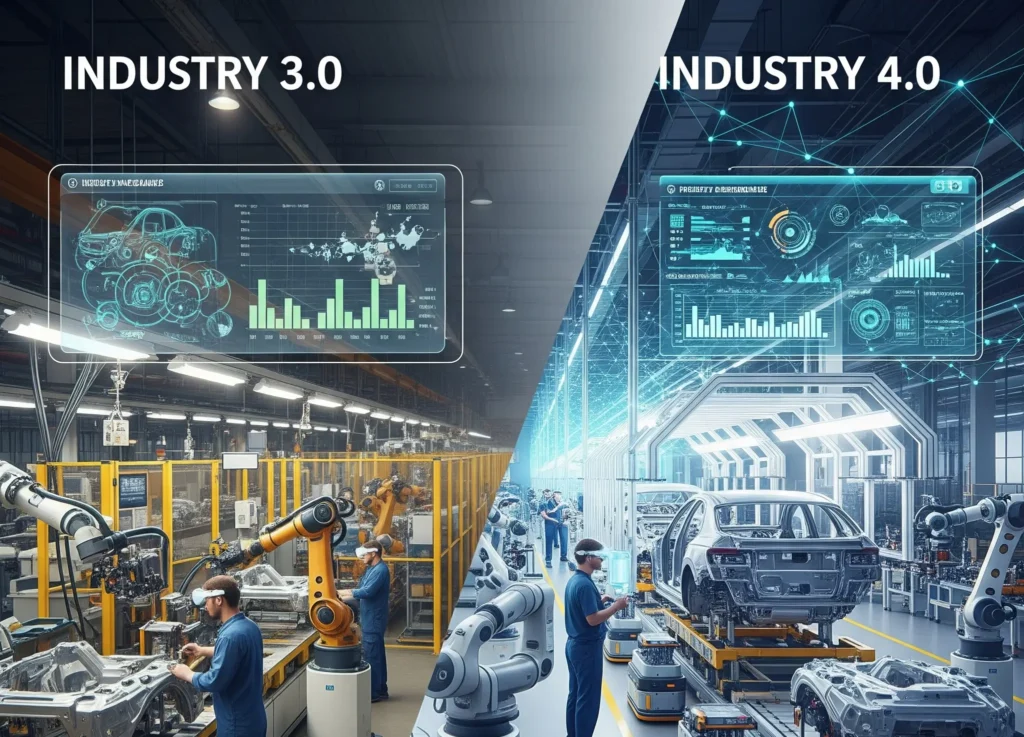
The Evolution of Manufacturing: From Industry 3.0 to Industry 4.0
Meeting the Demands of a Rapidly Changing Manufacturing Landscape
Advanced manufacturing methods are constantly evolving in today’s world, driven by growing demands for high-quality, customized products and the need for faster product development cycles. Manufacturers are under continuous pressure to optimize production, reduce costs, and eliminate errors—especially in the automotive and discrete manufacturing sectors.
To meet these expectations, the need for advanced industrial solutions that enhance manufacturing and machining processes is now more pressing than ever.
The Shift from Industry 3.0 to Industry 4.0
The industrial sector is witnessing a major transformation. While Industry 3.0 was characterized using computerized machinery, we are now entering the era of Industry 4.0, a more resilient, decentralized, and adaptive manufacturing paradigm.
This shift is fuelled by customer demands for personalized products and services that are both time-efficient and cost-effective. In response, new technologies are being developed and standardized to support this next generation manufacturing approach, enabling faster realization of product development and smart service delivery.
Real-World Manufacturing Challenges on the Shop Floor
Despite technological progress, the reality on the shop floor often reflects significant challenges. Manufacturers frequently struggle with inefficiencies, high inventory costs, and rigid production lines that aren’t designed to meet modern customization needs.
In the automotive industry, for instance, OEMs (Original Equipment Manufacturers) are being pushed to deliver vehicles packed with an increasing number of features and options. The growing expectations of tech-savvy consumers worldwide are fuelling fierce competition and the need to offer personalized, high-quality products quickly and cost-effectively.
Rise of Mass Customization and Its Impact on Automotive Production
As customers gain more control over the customization of their vehicles, traditional mass production techniques are no longer sufficient. Manufacturers must now accommodate a broader range of configurations and still maintain efficiency, speed, and precision.
This trend has led to a dramatic increase in vehicle configuration combinations, placing additional stress on automotive suppliers. They are now challenged to keep inventory levels low while also delivering on-time, high-quality products at competitive prices.
Toyota: A Case Study in Flexible Manufacturing
One of the most successful examples of adaptable production in the automotive industry is Toyota. The company’s flexible production system allows customers to select from a wide array of infotainment features, interior finishes, and hybrid powertrain options.
However, accommodating these configurations—especially when decided close to the manufacturing date—introduces new complexities. Components such as specialized electronic modules and custom wire harnesses can require lead times of 8 to 10 weeks due to overseas sourcing and supply chain logistics.
Moreover, the volatile nature of global demand adds to the challenge, causing supply chain delays and necessitating higher downstream inventory. As a result, suppliers are forced to carry additional inventory, further complicating the cost and efficiency equation.
Final Thoughts
The transition from Industry 3.0 to Industry 4.0 is not just a technological upgrade, it’s a fundamental shift in how manufacturing and supply chains operate. Automotive and discrete manufacturers must adopt intelligent, agile systems that support real-time customization, inventory optimization, and supply chain flexibility.
With rising customer expectations and product complexity, companies that embrace digitization and integration will be best positioned to thrive in the era of smart manufacturing.