




Line Side Replenishment
Lineside replenishment ensures the right material reaches the right workstation at the right time, based on actual consumption rather than fixed schedules or manual triggers. By digitally managing material flow at the line, manufacturers prevent shortages, avoid excess buffer stock, eliminate disruptions, and maintain uninterrupted, lean, just-in-time production.
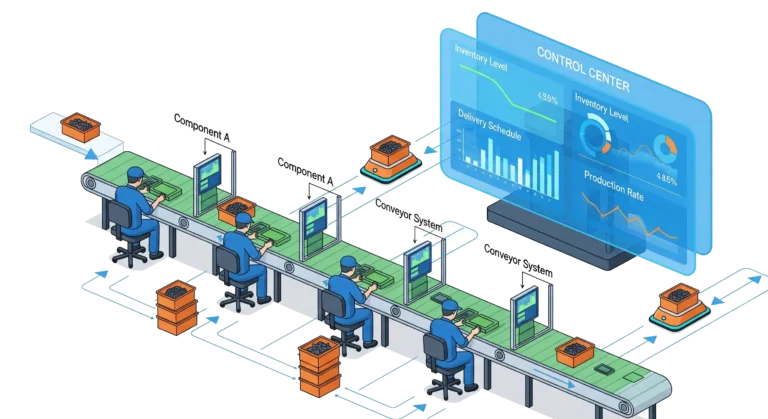
What Lineside Replenishment Does
Lineside replenishment ensures that materials consumed at each station are continuously monitored and replenished based on actual production demand.
Instead of overstocking the line or relying on last-minute calls from operators, replenishment is triggered when material levels reach predefined thresholds.
In high-mix, high-volume manufacturing environments, effective lineside material management is essential to maintain takt time adherence and production discipline.
Key Benefits
- Continuous material availability
- Reduced excess inventory at the line
- Better coordination between production and logistics
- Demand-driven "Pull" system
How HelmApps Digitizes Replenishment
HelmApps digitally connects production, material consumption, and internal logistics into a single, synchronized system.
Real-Time Tracking
Material usage at each station is tracked in real time through production confirmations, scans, or system-driven consumption logic.
Threshold Detection
Based on live data, HelmApps automatically identifies when material levels approach defined minimum thresholds.
Instant Requests
Replenishment requests are generated instantly and routed to the appropriate logistics team without manual follow-ups or phone calls.
Full Visibility
Supervisors and logistics teams get complete visibility into pending, in-progress, and completed replenishment activities.
Core Capabilities
Synchronizing consumption and logistics with real-time digital triggers.
Consumption Monitoring
Monitors material usage via production scans and system confirmations, identifying consumption the exact moment it happens.
Automated Triggers
Supply requests generate instantly when stock hits minimum levels, eliminating manual calls and guesswork.
Smart Routing
Orders are routed directly to logistics teams with full visibility into task priority and timing.
Consumption Trends
Track material usage patterns across lines and stations to optimize inventory levels and predict future needs.
Task Management
Logistics teams receive clear, actionable tasks with status tracking from creation to completion.
Shortage Alerts
Proactive notifications identify material risks before they cause line stoppages or production delays.
Challenges with Manual Replenishment
Many factories still depend on manual or semi-manual replenishment processes that create bottlenecks and inefficiencies.
Missed Signals
Replenishment requests get lost or delayed in verbal communication chains.
Over-Buffering
Excess materials accumulate at the line due to lack of real-time consumption data.
Experience Dependency
Replenishment timing relies heavily on individual operator knowledge and judgment.
Limited Visibility
Supervisors lack insight into material consumption patterns and future needs.
Reactive Firefighting
Logistics teams constantly rush to resolve urgent material shortages.
Reactive Mode
Without real-time visibility, replenishment becomes reactive rather than proactive.
Built for Real Shop Floor Conditions
HelmApps is designed for real-world shop floor conditions, not ideal scenarios. Unlike standard warehouse software, HelmApps is built for high-mix manufacturing environments.
Operators interact with a simple, intuitive interface that minimizes disruption to production workflows.
Logistics teams receive clear, actionable replenishment tasks with full visibility into priority, status, and timing.
Supervisors and managers gain real-time dashboards that enable faster decision-making and better coordination across teams.
Business Impact
Measurable improvements that drive operational excellence and continuous improvement.
Reduced Line Stoppages
Eliminate production downtime caused by material shortages. Ensure stations are fed based on real consumption data rather than estimates, maintaining continuous flow.
Lower Shop Floor Inventory
Reduce excess floor-side buffer stock and reclaim valuable shop floor space by moving to a demand-driven "Pull" system that delivers materials exactly when needed.
Higher OEE
Maintain consistent production discipline and schedule stability, leading to measurable improvements in Overall Equipment Effectiveness.
Improved Schedule Adherence
Better coordination between production and logistics ensures consistent adherence to production schedules and takt time requirements.
Reduced Manual Coordination
Eliminate phone calls, walkie-talkie communications, and manual follow-ups. Teams shift from reactive firefighting to proactive execution.
Continuous Improvement
Establish a controlled, predictable material flow process that provides the foundation for ongoing optimization and lean manufacturing initiatives.
Connected MES Framework
Lineside replenishment is not a standalone function. It integrates seamlessly with the broader HelmApps ecosystem to ensure material movement, production execution, and traceability operate within a single, connected MES framework.
Scalability for Your Business
Whether you run a single assembly line or manage multiple plants across different locations, HelmApps’ Line Side Replenishment can scale to match your production needs. The system adapts to different product types, order volumes, and production speeds, making it ideal for industries ranging from automotive and aerospace to electronics and consumer goods.