




Why Lean Manufacturing Matters Today – And How HelmApps Brings It to Life
The Origin of Lean Manufacturing: Doing More with Less
Lean manufacturing was originally developed as a method to maximize resource utilization by minimizing waste. Over time, it evolved to address the ever-changing and competitive business landscape, where agility, cost-efficiency, and responsiveness are key.
At its heart, lean manufacturing is about achieving more with less—less cost, less space, less time, and less effort. In today’s fast-paced world, where industries are challenged by rising customer expectations and shifting market conditions, adaptability and continuous improvement have become essential to long-term success.
The Need for Lean manufacturing
Whether it’s a product-based or service-oriented business, survival today depends on the ability to adapt, systematically and continuously. To enhance the perceived value of a product, organizations must constantly refine their operations and eliminate inefficiencies.
That’s where lean systems come in. By focusing on value-adding processes and eliminating those that don’t contribute to end-customer satisfaction, companies can improve output, reduce waste, and drive growth. Implementing a Lean Manufacturing System is now considered a critical competency for sustainable business practices across industries.
Toyota’s Role in Lean Evolution
Toyota played a pivotal role in shaping the lean philosophy. While many regard lean as purely a waste reduction strategy, it seeks to maximize value to the customer by minimizing waste across every process.
Lean principles are built around identifying Value-Added (VA) and Non-Value-Added (NVA) activities. This includes:
- Understanding the customer’s definition of value,
- Aligning production with real-time customer demand (pull-based systems),
- And striving for continuous improvement.
Common NVA wastes include transportation, inventory, motion, waiting, overproduction, overprocessing, and defects. These are obstacles to efficiency and often the root of operational delays and rising costs. Eliminating these wastes through lean practices unlocks significant performance improvements.
ERP Software and the Push vs. Pull Dilemma
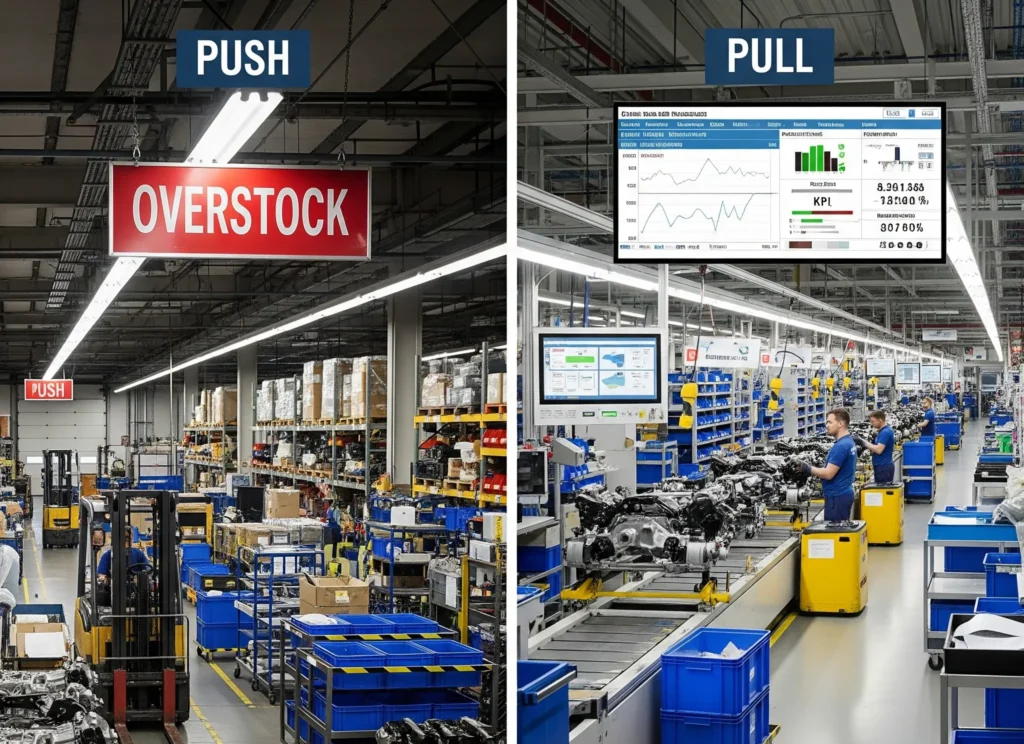
Most traditional Enterprise Resource Planning (ERP) systems support a push-based model, where goods are produced based on forecasts and pushed into inventory, hoping they match future demand. While this approach relies heavily on long-term projections, it often leads to excess inventory, inefficiencies, and missed customer needs when those projections are inaccurate.
In contrast, lean production thrives on a pull-based approach. Here, real demand triggers production, be it from a customer, a manufacturing process, or a trading partner. This model reduces overproduction and aligns production with actual consumption, making it a perfect fit for lean manufacturing principles.
Bridging the Gap with HelmApps: Enter JITS
This is exactly where HelmApps makes a difference.
Our proprietary JITS (Just-in-Time Sequencing) technology is designed to help automotive suppliers operate in a truly lean environment, delivering the right parts at the right time, reducing delays, cutting costs, and minimizing inventory waste.
At the core of JITS is a powerful sequencing engine that aligns long-term planning with real-time execution on the shop floor. It ensures suppliers know:
- What to build
- When to build it
- And in what order to build it
This precise sequencing is driven by the real-time manufacturing demands of OEMs, enabling suppliers to move from reactive planning to predictable, synchronized execution.
Smarter, Leaner, More Connected Manufacturing
JITS does more than just streamline production—it connects the dots between enterprise planning systems and ground-level operations. And because it integrates seamlessly with any ERP software, HelmApps empowers suppliers to:
- Eliminate unnecessary inventory,
- Respond quickly to changing requirements,
- And ensure on-time delivery of custom-configured products.
Our JIT-S module redefines lean production, not just as a process, but as a responsive, intelligent, and error-proof solution to modern manufacturing demands.
Final Thoughts: Lean manufacturing Reinvented with HelmApps
Lean manufacturing is no longer a “nice to have”, it’s a strategic necessity. And while lean principles offer a strong foundation, it’s smart, adaptable solutions like HelmApps’ JITS that truly bring lean to life in today’s complex manufacturing ecosystems.
By embracing pull-based sequencing, real-time communication, and seamless ERP integration, HelmApps helps companies do more with less, not just in theory, but in measurable execution.